Check these boxes for your training and you’ll build muscle and burn fat
I’m not an accountant, or a carpenter (although I’ve become good at building shelves) or a farmer (though I am pretty good at growing peaches). Unlike fitness training which seemed to make sense to me early on, I find many things confusing which is why I prefer to have others do it unless I want to take it on as a personal challenge. I also know many of my people can find the world of fitness training confusing, so I don’t hold it against them. That’s what fitness professionals like yours truly are for.
One of the key things that is a valuable tool for creating training programs for various goals is having check lists. Having a checklist helps with being methodical, systematic and keeping things in balance. When it comes to designing well rounded strength programs, I like to think of it simply.
- Upper body push like bench press
- Upper body pull like chin ups or lat pulldowns
- Knee dominant movement like squats or lunges
- Hip dominant movement like deadlifts and kettlebell swings
As long as the criteria are met, it’s going to be well rounded as long as the volumes and loads are in balance (unless you need to correct an imbalance). If there is room in the program, I can add a bridging type movement (like a hip thrust for physique goals) or an explosive power movement (like kettlebell swings or barbell cleans or something along those lines) for athletic goals.
Recently I was watching a lecture by Alwyn Cosgrove who is one of the thought leaders when it comes to fat loss training. I had purchased his fitness professionals program design bible years ago and often refer to it. Also recently bought his book, secrets of successful program design and read it when I get a quiet moment. Anyway, at the end of a lecture filled with scientific studies he had a summary, which I can use a checklist to balance out all that I’ve learned about training info I’ve pulled from various sources to tweak and modify what I already know and optimize it even further.
- Full body training with weights (hit the entire body)
- Include explosive lifts (like kettlebell swings or slam balls)
- Use paired or circuit formats (density)
- Rest pause techniques or cluster sets (density)
- Select non competing exercises (some exercises pair better than others)
- Mechanical advantage extended sets (accumulate fatigue metabolites)
Couple that with supportive nutrition (prioritize protein and water and just make sure your calories are in the right ranges) and you have a program that adds up to rapid and sustainable results. The good news is you don’t have to figure any of this out. When my car starts acting funny, I could try to figure it out, or I can take the direct path and outsource someone else’s knowledge, or in other words take it to a mechanic.
I have a free trial so you can see if it’s for you. Just send me a text at 973 476 5328 and introduce yourself to get started.
Eric Moss is a personal trainer in Boonton and moonlights as a world-record-holding modern-day professional performing strongman, author, and motivational speaker. In the tradition of the strength performers more common during the turn of the century, he performs feats of strength such as bending steel and breaking chains as part of a live show and travels across the country doing presentations on goal achievement for conferences, corporations, associations, nonprofits, and government entities as well as for schools and universities. His personal training studio is located on Main Street in Boonton New Jersey and is close to Mountain Lakes, Denville, Montville, Kinnelon, Pine Brook, Butler, and Parsippany New Jersey.
Effective Fat Loss Strategies Explained – 5 min read
I’ve been a personal trainer for over 20 years at this point and I’ve seen a lot come and go. Some of it had merit and stuck around, some of it had merit and for various reasons fell back into obscurity and some of it just simply sticks around even though it doesn’t work.
That would be using cardio as the primary driver for fat loss training.
an example of what I’m talking about
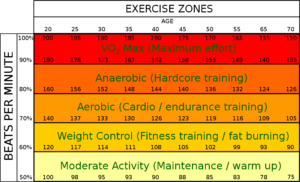
When I first started out as a personal trainer, I remember seeing a graphic on the treadmills indicating the fat burning zone (which is largely a myth based on a misinterpreted scientific study) and the cardiovascular zone and they were indicated with various colors. There is a particular franchise with a fruit color theme as part of their brand which bases their philosophy on that.
The only fruit I would even consider being part of my brand would be peaches. 🍑
Anyway, what’s funny is one of my clients recently said she wants to get me a lab coat because I come at it from a scientific mindset. Effective program design is a form of art and I’m probably more of the artist sort with open paint cans and such, but I do pay attention to science as well.
The main reason why, is when I make claims, I’m not making it as “just trust me bro” I can say, this is what the science says.
“And a meta analysis of over 400 scientific studies conducted over the past 25 years on fat loss research concluded that aerobic training does not provide a significant advantage over dieting alone.” International Journal Obesity Metabolic Disorder
Why?
Think of how we evolved. Back before you could simply get a cheeseburger with fries at a drive through, prehistoric humans had to survive through various periods of famine. When food was a surplus, it would get stored in the event of another famine. Fat contains 9 calories per gram, while protein (ie muscle) and carbohydrates (ie glycogen) each only have 4 calories per gram. This makes fat more valuable than the other two in the prehistoric survival sense.
Fortunately we don’t live in those times anymore. You can go to the local grocery store and get food without having to hunt it down or farm it. Unfortunately we have those same prehistoric mechanisms at play thinking it might have to keep us alive. Survival at all costs.
Here’s how this plays out in the real world. In order for fat loss to occur there has to be a caloric deficit, as in the calories coming in have to be higher than the calories going out. Calories coming in, would come from your food. The calories going out come from a couple different places though.
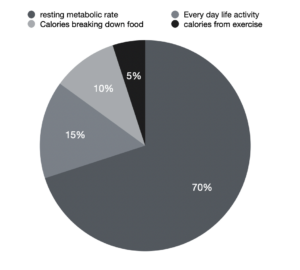
The first and biggest one would be your base metabolic rate (ie resting metabolic rate). This is the energy it takes to keep your heart beating, your immune system working, your body repairing itself, your lungs functioning etc. This is also the biggest contributor and varies from person to person which is why some people can get away with eating a lot, while some people just look at food and gain weight. Your base metabolic rate represents approximately 70% of your total daily caloric burn.
The second biggest contributor to your daily caloric burn would be your everyday life activity. This covers the various things you do during the day from getting your mail, to picking your nose, fidgeting in your seat, playing with your kids, carrying the groceries, gardening, flipping people off on 287 south and walking to the bathroom. This would be approximately 15% of your daily caloric burn.
Next would be the thermic effect from food. Basically when you eat food it takes energy to break it down, digest it and turn it into energy. The amount of calories it takes to do that is about twice as high with protein (which is why you get the meat sweats when you go to a Brazilian grill) as it is with carbs and fats. This would represent about 10% of your daily caloric burn.
Then the last 5% would be the calories you burn during a workout. 5% is a really small number and shouldn’t be the one you focus on. This majoring in the minors is what those cardio oriented workouts focus on.

Now you read that calories coming in have to be lower than calories going out. But because our bodies are still running on that survival at all costs mode leftover from the Paleolithic era, trying to create that deficit by trying to burn it off with cardio becomes like a dog chasing its tail.
Too much and your body subconsciously down-regulates your daily activity, and/or upregulates your hunger in an attempt to make up for those lost calories. You fidget less, you sit down more, you eat more because you’re hungrier, you lay down and veg because you’re exhausted. You are essentially working against yourself.
What I focus on with my clients is building muscle, which increases that base metabolic rate (the biggest daily caloric burn contributor) and signals your body to burn fat instead of muscle. And if you are getting a lot of protein (the highest thermic effect) you’ll not only feed the muscles their building blocks, but you’ll be satiated so you’ll be too stuffed to even want that pint of Ben and Jerry’s.
Even if you go excessive with the calories from protein, for some reason they don’t get stored as fat. They’re free. And yes there is a study to back that up too. The people in this study had a daily excess of 880 calories from protein, and it didn’t get stored as fat https://pmc.ncbi.nlm.nih.gov/articles/PMC4022420/
And no, building muscle won’t bulk you up too much. Going back to that Paleolithic era analogy, your body thinks it doesn’t want excessive amounts of muscle because it would take too many calories in the event of a starvation cycle to maintain it. That’s also why people have to resort to performance enhancement drugs, because your body has built in protection mechanisms to put a halt on it.
So in essence, it’s a 3 part equation.
- Help create a caloric deficit by building your basal metabolic rate by building muscle.
- Prioritize protein to help build/keep muscle while taking advantage of the thermic effect of food and can help keep you satiated in a caloric deficit.
- Maintain a caloric deficit by not eating excessive amounts of calories.
With the training plans I do, I help my clients get way stronger in the ranges that build muscle, and can do so in a caloric deficit which completely transforms their physiques. I’ll talk a bit about this in a future post so stay tuned.
I know I threw a lot at you with this article, but I hope you learned something. If all this is still confusing to you, don’t worry, this is what I do and I figure it out for you, all you have to do is show up and follow the plan. I offer a free trial so you can test drive it yourself. Just send me a text at 973 476 5328 and introduce yourself to get started and we’ll take it from there.
Eric Moss is a personal trainer in Boonton and moonlights as a world-record-holding modern-day professional performing strongman, author, and motivational speaker. In the tradition of the strength performers more common during the turn of the century, he performs feats of strength such as bending steel and breaking chains as part of a live show and travels across the country doing presentations on goal achievement for conferences, corporations, associations, nonprofits, and government entities as well as for schools and universities. His personal training studio is located on Main Street in Boonton New Jersey and is close to Mountain Lakes, Denville, Montville, Kinnelon, Pine Brook, Butler, and Parsippany New Jersey.
Box Jumps, Yay? or Nay? as part of a training program
I used to be right all the time. That was in my first marriage which lasted less than a year, but I learned from that experience and applied it to my marriage now and just had our 10 year wedding anniversary so I haven’t been right in over a decade. To be fair though, my ex wife wasn’t that bright and my wife now probably is smarter than I am. She keeps me around though because she can’t handle dealing with spiders or the clog in the shower drain and those are things I can handle without issue.
When I first embarked down the road as a fitness professional I made a lot of mistakes but I learned from them. I experimented with many things from workout machines, traditional weight training, to fitness bootcamps, kettlebells, calisthenics, corrective exercises and probably a ton of things across a 20 year career I’m forgetting at the moment. Some of it had merit so I kept it around adding it to my quiver, and some of it I found to be complete nonsense so I got rid of it.
Yesterday one of my long time clients came to me with a question out of the blue.
“What do you think of box jumps?”
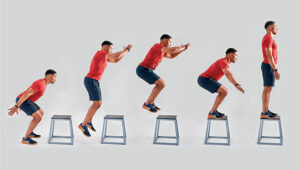
pic via https://experiencelife.lifetime.life/article/break-it-down-the-box-jump/. I don’t claim ownership of this
“The risk reward ratio just isn’t there, and I think anything it can do, can be done better with a kettlebell swing which has less impact and safer….why?”
She proceeded to tell me that one of her friends, was doing a circuit bootcamp type of deal which had box jumps in it and had broken her foot. She has a wedding next week, and a vacation the week after that. Now with a broken foot, her summer is ruined.
I don’t often like to poke holes in other people’s programs when I don’t know the full story, but I’m pretty sure it’s a bad one. Before putting an exercise in one of my clients programs, I ask myself…why? What purpose does it serve in the program? Does it affect other exercises in a negative way? What could go wrong?
In the case of the box jump, it does have some sport specific applications for power development but 9 times out of 10, I’d put the kettlebell swing or snatch, barbell clean, hexbar jump, or rear foot elevated split squat jump in there first. And when I say first, it would literally be the first exercise performed. Power is best developed while fresh, not under fatigue.
Fatigue while somewhat useful for building muscle or conditioning also brings issues. Form tends to go south while tired and in the case of the box jump, that’s not the sort of thing you can get away with while being sloppy…too much can go wrong.
Gashing your shins open (fairly common) is the lesser of the evils. Falling backward or forward and cracking your head open being the greatest of all possible evils and, rupturing a tendon or breaking your foot is somewhere in between.

Doing it as part of a circuit, is quite simply a bad idea. I hope the trainer learns from it.
In the case where I might use it, it would be for a young athlete that needs that specifically, like for a test or something. Definitely not for the average person that simply wants to look and feel better. Nothing makes you feel better than spending your summer vacation in a cast.
So the takeaway? Just say “no” to the box jump. Say “yes” to safe and effective training that puts you closer to your goals. The good news is you don’t have to figure this out yourself. I can put a program together for you that gets you to your goals, quickly, safely and sustainably. I also offer a free trial so you can see if you like it before making any kind of decision. Just send me a text at 973 476 5328 to get started.
Eric Moss is a personal trainer in Boonton and moonlights as a world-record-holding modern-day professional performing strongman, author, and motivational speaker. In the tradition of the strength performers more common during the turn of the century, he performs feats of strength such as bending steel and breaking chains as part of a live show and travels across the country doing presentations on goal achievement for conferences, corporations, associations, nonprofits, and government entities as well as for schools and universities. His personal training studio is located on Main Street in Boonton New Jersey and is close to Mountain Lakes, Denville, Montville, Kinnelon, Pine Brook, Butler, and Parsippany New Jersey.